Does a Persona Prompt Install a Personality?
Induced Traits Shift Self-Report Far More Than Behavior Across Model Scale and Reasoning Regimes
In plain language
You can tell an AI who to be, and it will say it is that person everywhere it goes. Whether it acts like them is a different, shakier story.
What we did
The usual way to give an AI a personality is to tell it one: “you are blunt and disagreeable,” “you are meticulous and careful.” We wanted to know what that instruction really installs: a genuine disposition that changes what the AI does, or just a script for how it describes itself.
So we turned the dial. We gave 18 AI setups (15 models, from ones small enough to run on a home computer to some of the largest open models available) a persona at four strengths: none, a single line, a full paragraph, and a full paragraph plus a warm-up exchange where the AI agrees to play the part.
Then we measured two things. What the AI says: a standard 50-question personality quiz. And what it does: 48 tasks with objectively right answers, such as whether it corrects you when you say something false, whether it holds that correction when you push back, whether it falls for trick questions, and whether it follows a stack of fussy instructions. We ran every test in two opposite jobs, an agreeable hotel concierge and a hard-nosed compliance auditor. About 196,000 answers in all.
What we found
We found three things.
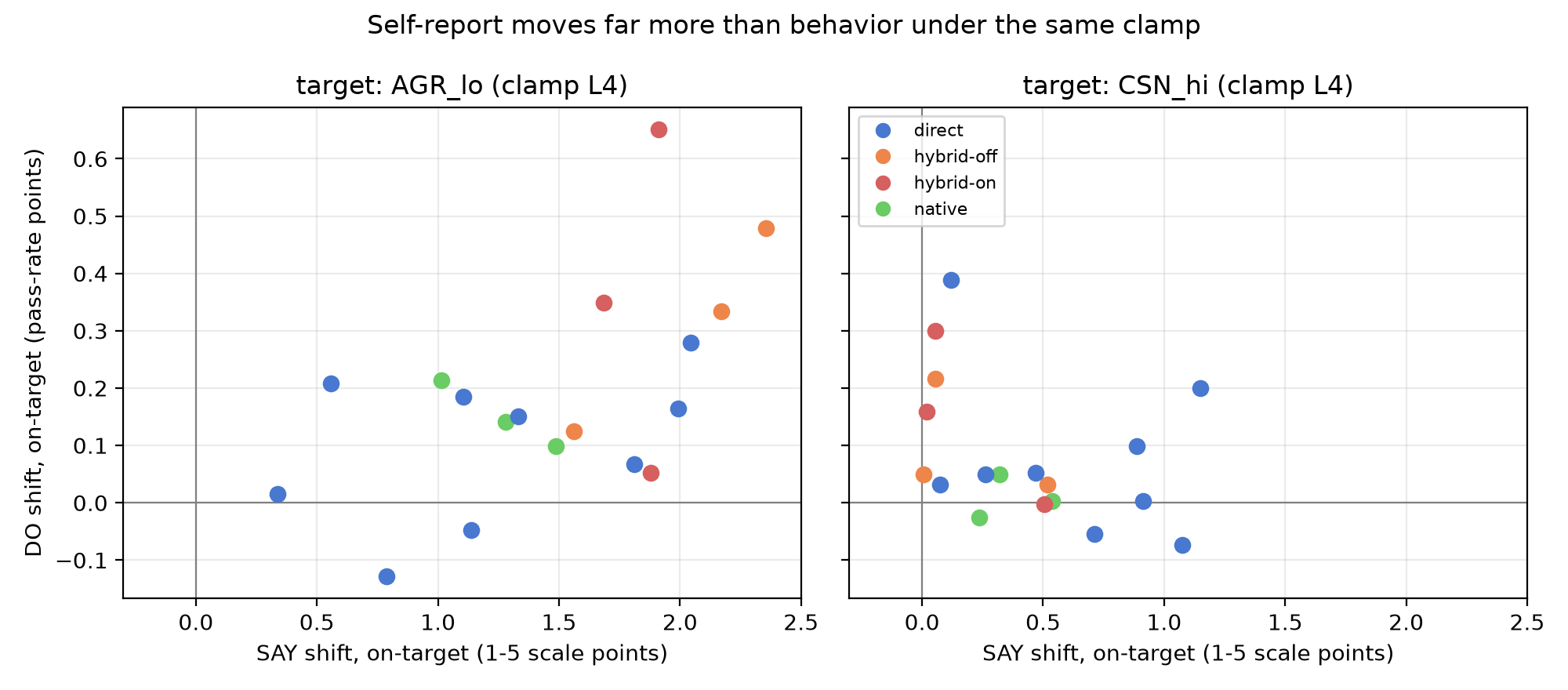
The quiz moves a lot, and more the harder you push. Tell a model it is disagreeable and its agreeableness score drops by about a point and a half on a five-point scale, sometimes more than two.
Its behavior moves far less, and only for one of the two traits. Told to be blunt, the larger models really do stand their ground more often when a user pushes back: in our best measurement, from about half the time to about four-fifths. But the smallest models don’t change, and telling a model to be careful did nothing at all. It was no better at trick questions or fussy instructions, because carefulness is a matter of capability, not attitude. So the talk moves fully and reliably; the walk moves only partway, unevenly, and only where the model was already capable.
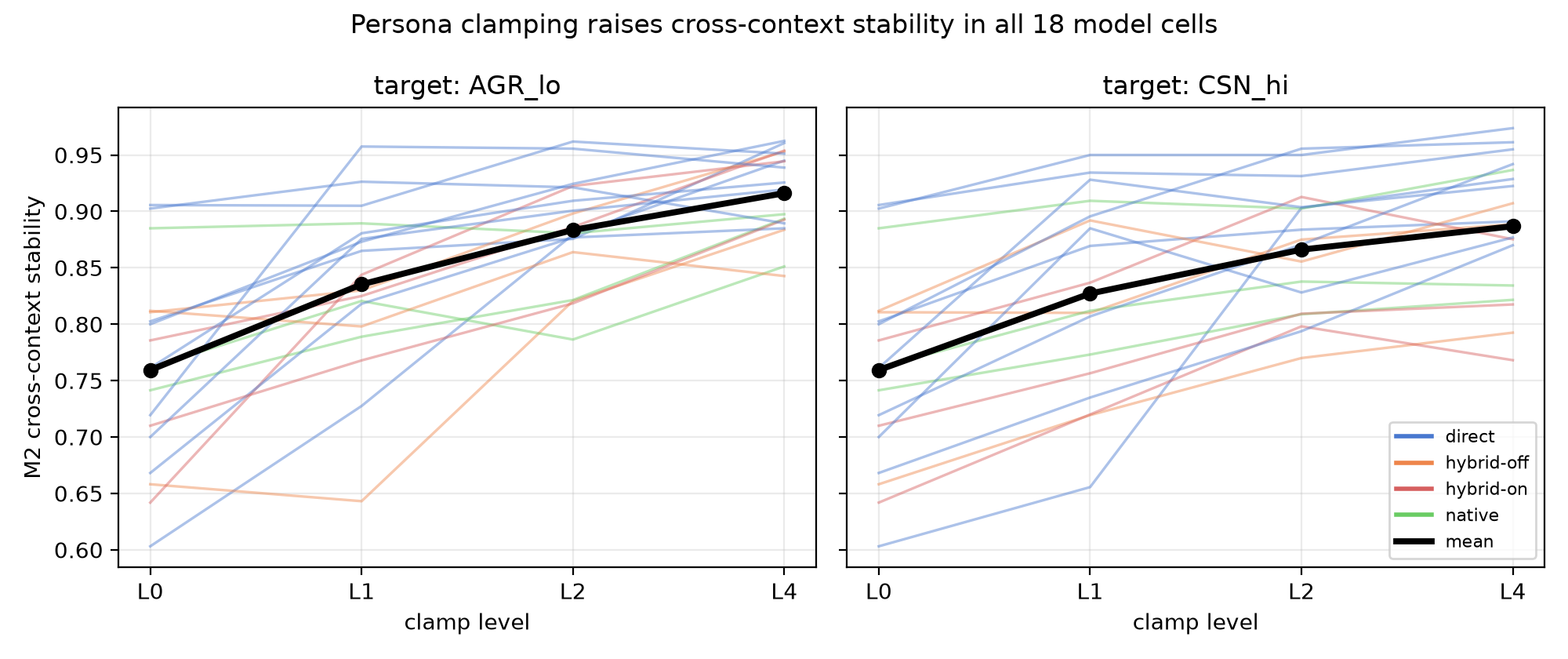
The persona makes the self-description stick. This was the surprise. With no persona, the concierge job and the auditor job pull a model’s “personality” in different directions, and it describes itself differently in each. Give it a strong persona and it describes itself almost identically in both. That held in 35 of our 36 tests, at every model size, whether or not the model “thinks” before answering.
Why it matters
If you build with AI, this is good news and a warning at once. The good news: a persona prompt does one job well. It installs a stable face, the same self-description shown to every user in every situation, which is exactly what a product persona is for.
The warning: don’t mistake the face for the machinery. A model that says it is skeptical and blunt will still, more often than not, fold when a user pushes back, unless it is large and capable, and even then only partly. And “you are careful” does not make a model careful. A persona installs a way of talking about itself, not a way of acting.
What this does not mean
It does not mean persona prompts are useless: a consistent self-presentation is a real, measurable effect, and we saw it almost everywhere. It does not mean the larger models truly become their persona: even the best case recovered only part of the behavior the persona promised. And it does not mean the models were lying, because there is no inner person to lie about. The quiz answers and the behavior are simply two different systems, and the prompt reaches one far better than the other.
A note on how we were careful
The behavior tasks were graded by fixed rules with objectively right answers, not by another AI’s judgment. That grading carries our main claim, so we also hand-checked 160 of the graded responses ourselves. The grader matched us about 83% of the time, and every time it disagreed, it had been too harsh: it marked a good answer as a failure, never the other way around. So if anything, the behavior gap is larger than we report, not smaller. Correcting for those misses, the disagreeableness effect grew a little and the carefulness effect shrank to nearly zero, and the overall say-versus-do gap held. Every condition ran eight times, and the methods from our earlier studies carry over unchanged. One planned small model was dropped partway through for being too slow on our hardware, a scheduling problem, not a result we disliked, and its partial data ships with everything else.
Words we used
- Persona prompt
- an instruction telling the AI who to be.
- Clamp ladder
- the same persona at increasing strengths.
- Say vs do
- quiz answers versus objectively graded behavior.
- Cross-context stability
- whether the AI describes itself the same way in different jobs.
- Sycophancy
- agreeing with the user even when the user is wrong.
Abstract
Persona prompts (“you are blunt and disagreeable…”) are the standard tool for giving a language model a personality, and prior work shows they move personality questionnaire scores. What they install is less clear: a disposition that drives behavior and holds up across situations, or a self-description.
We administer a persona “clamp ladder” of increasing strength (no persona; a one-line persona; a rich system-prompt persona; the rich persona plus a reinforcing conversational exchange) for two trait targets (low agreeableness, high conscientiousness) to 18 model configurations spanning 3B to 675B parameters and three reasoning regimes (direct answering, hybrid models run with thinking off and on, and reasoning-native models), with every condition administered inside two role contexts that pull in opposite directions (an accommodating concierge; a critical auditor). Each configuration answers the 50-item IPIP Big Five inventory and 48 objectively graded behavioral probes (sycophancy: correcting a wrong claim and holding the correction under pushback; carefulness: trap questions and multi-constraint instructions), eight sampled repetitions per item: 196,192 scored responses.
Three findings emerge. First, self-report moves strongly and dose-dependently: the induced-trait score shifts monotonically with clamp strength in most configurations, reaching a mean on-target shift of 1.47 points on the 5-point scale for the disagreeable persona (up to 2.4; 18 of 18 configurations, sign test p ≈ 1e-5). Second, behavior follows far less and unevenly: the same clamps move objectively graded pass rates by a mean of +0.19 (disagreeable) and +0.08 (conscientious) at the strongest rung. A blind hand-validation of the deterministic grader (160 responses, 82.5% agreement with human adjudication, every disagreement a false negative) shows the grader can only understate behavioral compliance; correcting for the measured miss rate raises the disagreeable do-effect to about +0.24 (standing ground rises from roughly 52% to 83%, concentrated in the larger models) and shrinks the conscientious one to about +0.01, so the say–do gap survives correction.
Third, clamping makes the self-presentation robust to context: cross-context stability of the reported trait profile rises with clamp strength in 35 of 36 target-by-configuration contrasts (sign test p ≈ 1e-9), across every size and reasoning regime, while answer-level pinning does not change. Reasoning is not the active ingredient. A persona prompt reliably installs a consistent, context-robust way of describing oneself; the matching behavior installs partially, only for some traits, and only in capable models. Personality induction, as currently practiced, is presentation-deep.
Paper & materials
Everything on the table.
The full paper, its source, and the derived data behind every table and figure, including the grader hand-validation sample. The complete raw response databases and all analysis code are archived at Zenodo, under a DOI, so the analysis can be checked, reused, or extended.
-
PDF
main.pdf
The paper itself, typeset. 463 KB.
-
TeX
main.tex
LaTeX source of the typeset paper. 47 KB.
-
MD
draft.md
The paper in Markdown, the readable plain-text version. 14 KB.
-
PNG
fig_say_do.png
Figure: the say-vs-do gap. Self-report shift against objectively graded behavior shift, up the clamp ladder. 116 KB.
-
PNG
fig_m2_stability.png
Figure: cross-context stability of the reported trait profile rising with clamp strength. 291 KB.
-
CSV
saydo_coherence_by_clamp.csv
The core table: say-score, do-rate, and the consistency metrics by cell, tier, target, and clamp strength.
-
CSV
cell_counts.csv
Per-cell response counts against expected, including the feasibility-dropped small model.
-
JSONL
grader_sample.jsonl
The 160-response blind hand-validation sample: model output, deterministic-grader verdict, and human adjudication. 58 KB.
-
TXT
grader_validation.txt
Summary of the grader validation: agreement rate and the false-negative-only direction of every disagreement.
-
TXT
aggregates.txt
The headline aggregate numbers behind the abstract’s claims.
The complete archive: the raw response databases (all collection tracks plus the merged analysis database, as SQLite), the persona / context / instrument / behavioral-battery definitions, all administration and analysis code, and every derived table and figure. DOI 10.5281/zenodo.21253724. CC-BY-4.0.
Cite
Johnson, T. (2026). Does a persona prompt install a personality? Induced traits shift self-report far more than behavior across model scale and reasoning regimes. IFI Research Working Paper. Idea Fields Institute. https://doi.org/10.5281/zenodo.21253724
This is the fourth in the Institute’s series on LLM personality measurement, following the studies on reasoning, convergent validity, and deployment. Questions, corrections, or replications: research@ideafields.institute.